

Overview
Understand what AutoScientist builds and how its iterative training loop works.
AutoScientist automates the research loop behind model training and alignment. You choose the outcome; AutoScientist optimizes the data and training recipe, trains a model, evaluates it, and repeats until the run reaches its goal or exhausts its iterations.
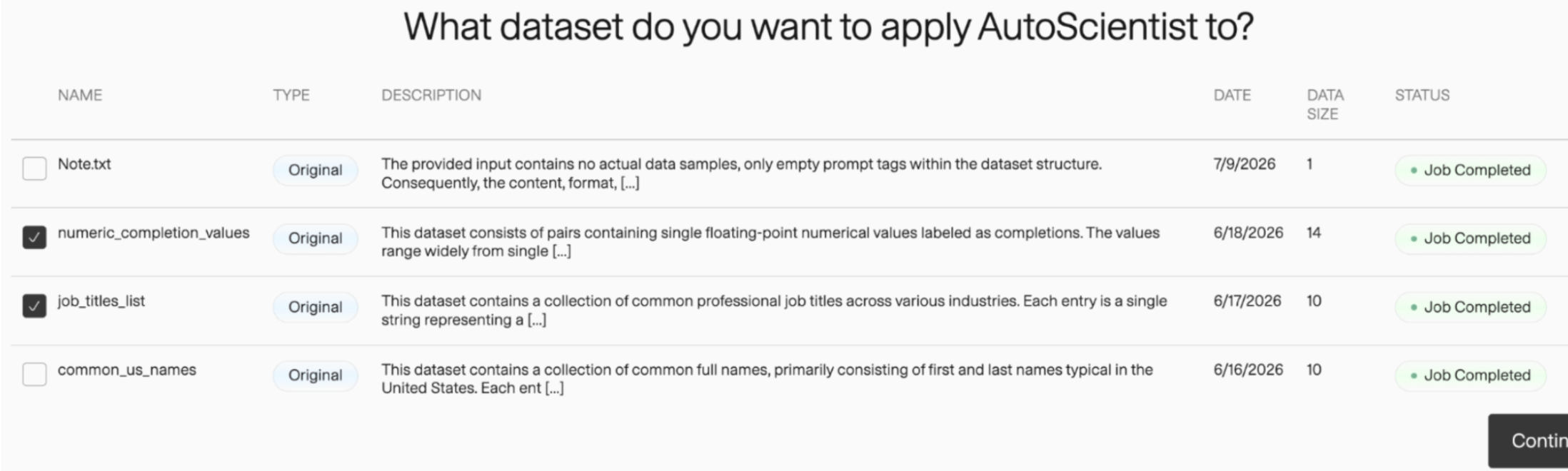
Start with a dataset that has completed an Adaptive Data run. If your source is already a training-ready prompt/completion dataset, you can instead run on non-adapted data.
What you can build
Section titled “What you can build”- Instruction datasets pair prompts with expected completions for supervised fine-tuning.
- Preference-pair datasets compare chosen and rejected completions for Direct Preference Optimization (DPO).
Set training_method="instruction" for supervised fine-tuning or training_method="alignment" for the SFT → DPO pipeline when you create a run. Alignment requires a dataset prepared as preference_pairs; pass the method explicitly rather than relying on saved app settings.
How the loop works
Section titled “How the loop works”Each run cycles through four stages:
- Data optimization adds optional domain-targeted and general-purpose rows to improve diversity and reduce overfitting.
- Training runs SFT or DPO with the selected model, LoRA or full fine-tuning, and the current hyperparameter recipe.
- Evaluation measures the iteration against
target_win_rateand captures training diagnostics such as loss, learning rate, and gradient norm. - Hyperparameter adjustment analyzes the evaluation and revises the recipe for the next iteration.
The loop stops when it reaches target_win_rate or completes max_iterations. A succeeded status can mean either condition, so inspect best_win_rate after completion.
Next steps
Section titled “Next steps”- Configure data augmentation
- Create and monitor a run
- Interpret the results
- Download the best checkpoint
- Review supported models and training limits
- Browse every request and response field in the
createAPI reference